![logo-black-no-padding.png]](https://www.hootreading.com/hs-fs/hubfs/logo-black-no-padding.png?width=100&height=83&name=logo-black-no-padding.png)
Getting Started
To access your child's Lesson History page, go to your parent profile in the Hoot Reading App. From the main menu, select Lesson History.
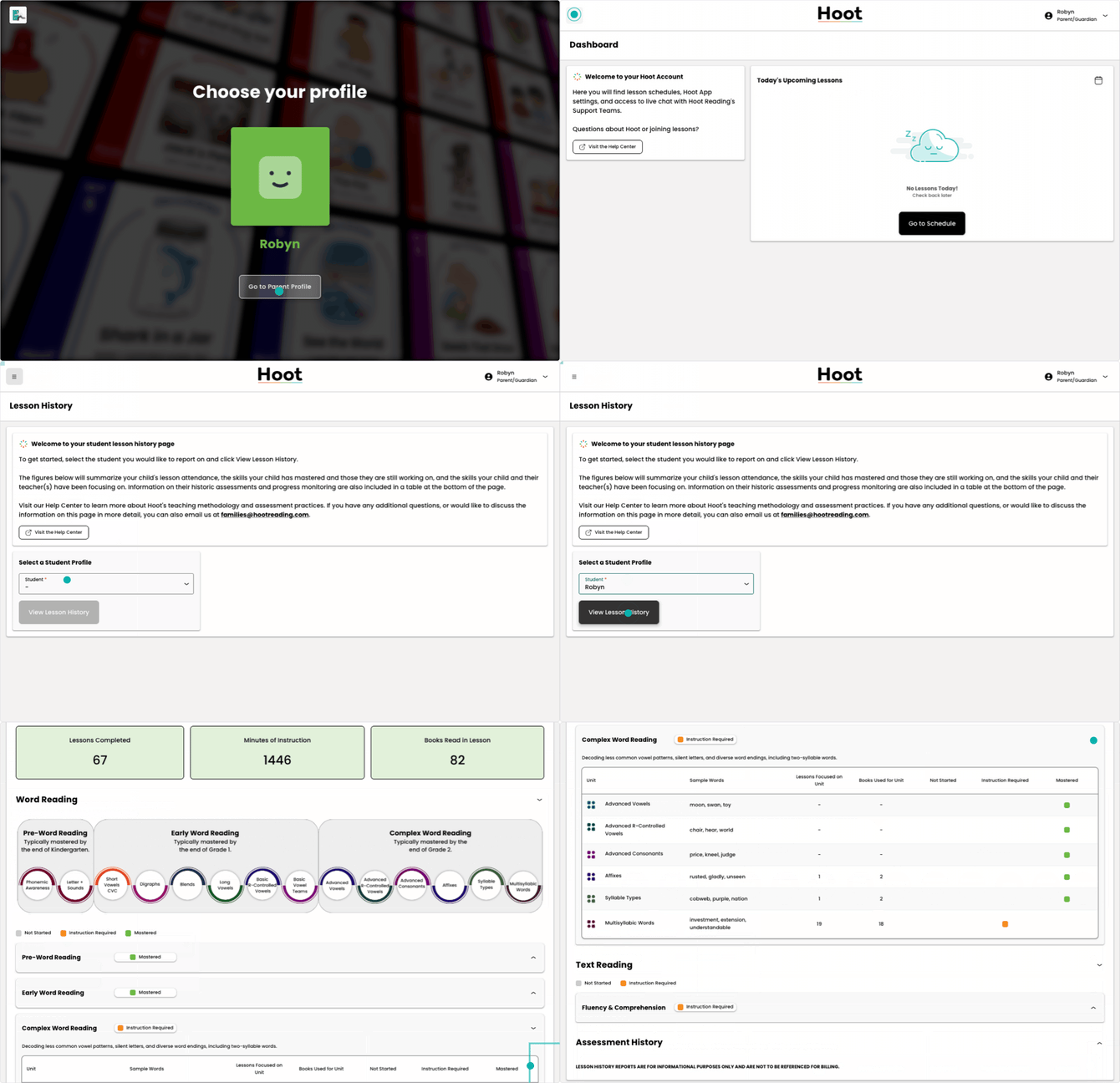
When you first land on the Lesson History page, you'll begin by selecting the child profile whose lesson history you would like to view. This applies only if you have more than one child registered for Hoot.
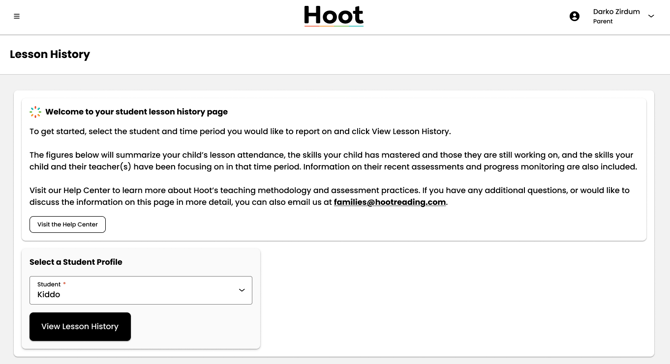
Once selected, this page will summarize your child's:
-
lesson attendance
-
instructional focus areas
-
progress across Hoot’s Scope & Sequence
-
and recent assessment results
If you ever want more detail about how Hoot teaches reading or your child's progress, you can contact us at families@hootreading.com.
Attendance: Understanding Lesson Activity

The Attendance section gives helpful context about how much literacy instruction your child has received through Hoot. You'll see:
-
Lessons Completed – the number of lessons your child has completed with a Hoot teacher
-
Minutes of Instruction – total instructional time your child has had with a Hoot teacher
-
Books Read in Lessons – how many books have been used for instruction in your child's lessons
Note: Attendance data reflects lessons completed since September 1, 2024.
Where Your Child Is in their Reading Journey
Word Reading
At the top of the Word Reading section, you’ll see a visual overview of Hoot’s Scope and Sequence. This is the visual progression of word reading (or phonics) skills taught at Hoot, grouped into three instructional focus areas:
-
Pre-Word Reading (typically mastered by the end of Kindergarten)
-
Early Word Reading (typically mastered by the end of Grade 1)
-
Complex Word Reading (typically mastered by the end of Grade 2)
These grade levels are approximate reference points, not expectations. Hoot instruction is always based on a child's unique skills, not age or grade.

Understanding the Unit Tables
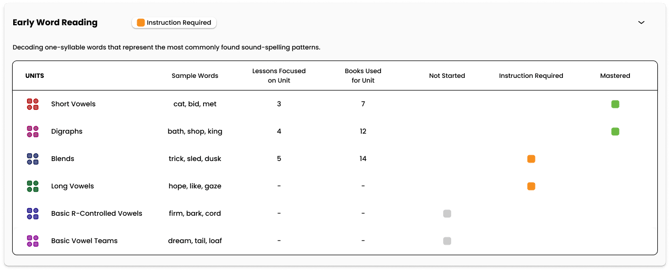
Within each of Hoot's instructional focus areas, you’ll see a table that includes:
-
Units – the specific reading skills
-
Sample Words or Tasks – examples of what that skill looks like
-
Lessons Focused on Unit – how many completed lessons focused on this skill
-
Books Used for Unit – how many books have been used for instruction to support development in a particular skill area
These counts provide context, not a checklist. Some skills naturally require more lessons and books than others.
Progress Indicators
The final columns show your child’s current instructional status for each unit, based on their Hoot Reading Assessment results:
-
⬜ Grey (Not Started)
The skill has not been introduced yet. -
🟧 Orange (Review or Instruction Required)
Your child requires additional review or instruction on this skill before mastering it. This may mean that the unit is currently in progress or has not yet been started and will be a focus in future lessons. -
🟩 Green (Mastered / Advanced Beyond)
Your child has demonstrated a strong understanding and has either advanced beyond this skill, without specific assessment, or they have been assessed and have shown mastery of the skill.
Why Some Sections Are Open and Others Are Closed
When you first land on this page, you may notice that only some sections are open, while others default to closed. To keep focus on what requires instruction now, only the instructional focus areas that currently require instruction or review are expanded by default. Fully mastered areas or areas that haven't been started remain collapsed to keep the page focused and easy to read.
Text Reading
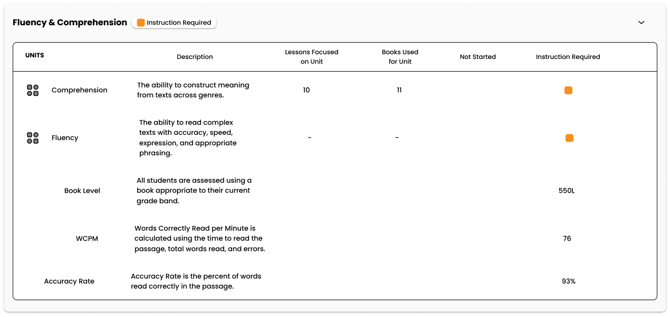
Text Reading focuses on how your child reads connected text, rather than individual words.
Comprehension
At Hoot Reading, comprehension skills are continuously developed at every stage of learning, so they are always marked as 🟧 Instruction Required. This reflects the ongoing support your child receives to grow their understanding of what they read.
-
While children are still developing Word Reading skills, teachers focus on Language Comprehension (listening, discussion, understanding meaning, building vocabulary).
-
Once children have mastered Word Reading, comprehension instruction shifts to Reading Comprehension, where the children works on their understanding of the text from reading it themselves.
Fluency
Fluency is practiced throughout the Word Reading units, but focused fluency instruction begins only after a child has mastered all word reading skills.
Before fluency instruction has started, this row will be shown as ⬜ Not Started.
Once instruction has begun, you’ll see:
-
Information about the Level of the book used to assess your child's fluency
Note: children are always assessed on a book at their grade level. Books get increasingly more complex from assessment to assessment. -
Their assessed Words Correctly Read Per Minute (WCPM) score
-
The calculated Accuracy Rate of their reading of the book they were assessed on.
If these fields are blank, it simply means your child isn’t at that stage yet.
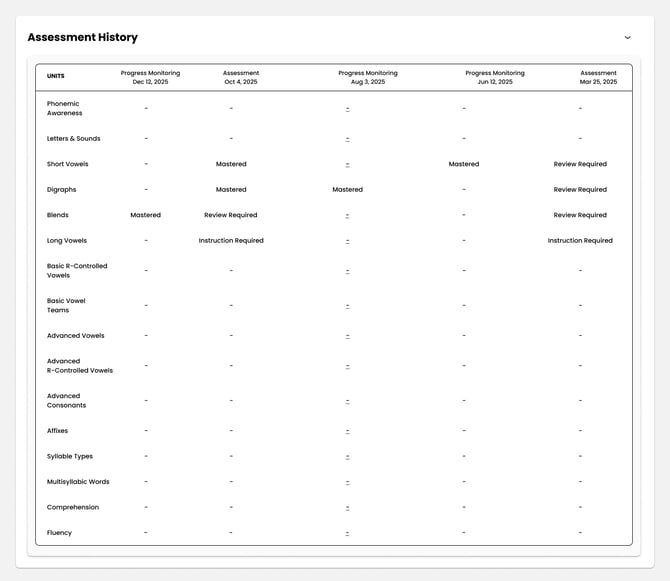
Assessment History
The final section shows your child’s full chronological assessment history.
Assessment columns show data from your child's diagnostic and summative Hoot Reading Assessments.
-
Only units that were assessed during a given assessment window will show an instruction indicator (Mastered, Review Required, Instruction Required).
-
A hyphen (–) means the child has advanced beyond the unit, or it was previously mastered and therefore not re-attempted on the assessment, or the unit has not yet been started.
Progress Monitoring columns show data from progress check ins.
- Only units that have been regularly worked on in lessons will be assessed on a progress monitoring check in. Those units that were assessed will be shown with an instruction indicator (Mastered, Review Required, Instruction Required).
- All other units are shown with a hyphen (–), indicating they were not part of that progress monitoring check in.
💡 Remember!
Children develop reading skills at their own pace. While teachers guide children through the Word Reading units in sequence, children may:
-
move quickly through some skills,
-
spend more time revisiting others,
-
and build new skills alongside previously learned ones.
The Lesson History page is meant to give you clarity and confidence in what your child is working on in their Hoot lessons, not pressure. If you ever have questions about what you see on the Lesson History page, we’re always happy to help.